Showing posts with label SCW. Show all posts

Friday, 29 November 2013

The Good, The Bad & The Garbanzos

We bade farewell to Aragón with a visit to the Italian positions atop Ermita Santa Quitería followed by an excellent lunch at Café Hermes in Tardienta. We also had a cup of coffee in Huesca. There was standing joke with the Republican troops on the Aragón front about "having a cup of coffee in Huesca tomorrow" - they never did. 

And so, back to Catalunya and a brief visit to Fayon and its Ebro Museum. The museum is incredible. All the things you would expect: uniforms, weapons and personal kit. Where it stands out is its full size dioramas of The Battle of The Ebro and also the VERY heavy weaponry on display. Artillery pieces, mortars, HMGs and AA artillery including and a complete, including sights, 88mm Flak36. Most impressive and well worth a visit.

Then up the road to La Fatarella. We were supposed to be lodging in La Fatarella village itself but some confusion over bookings led us to stay at the peasant farmhouse at Torre Nova about 3km away. Torre Nova was used as a dressing station/field hospital during the battle of the Ebro. We stayed here B&B but ate most of our meals at La Casa Ecologica in La Fatarella. Menú del día is a wonderful thing: choice of starters, mains and desserts plus as much wine, bread, water and coffee as you can cope with all for between 8 -12 Euros a head. Bonus!

Torre Nova Farmhouse
Field hospital during The Battle of The Ebro

Trenches on the ridge above Terra Nova

Saturday in La Fatarella: a conference on aspects of SCW. Went for a walk around the village with DW. Lunch in café Can Ríus with AW, PR & DW, met some interesting and knowledgeable people.

Sunday saw a re-enactment of the end of The Battle of The Ebro. The Nationalists were represented by a group of friendly Carlists. I know they were friendly they gave me strong sherry wine. They also colonised the Republican bunker, christened 'Fred & Ginger's' to get out of the incessant wind. The Republican troops contented themselves with manning the trenches.

The battle was short, 20 minutes or so, but great fun to be a combat correspondent in. As well as my digi I was also using a borrowed 35mm Leica. I think I got some good shots even though the Leica takes a little time to set up. One notable feature of the fighting was the extravagant use of pyros to create an artillery barrage effect and the number of home-made grenades being thrown by both sides. I was lying down on top of the bunker to get some good shots and got a present of a grenade which I managed to roll away from before it went off. If it had been a real one I'd be writing this from a hospital bed. Possibly.

A Carlist
Note how he has turned his blanket into a capote

Carlists in the tree line!

Republican defenders


Restored bunker from the battle

This is a short film taken by one of the other combat cameramen present. 
All acknowledgements and copyright belong to: Ramon Aragonés Margalef.


UATH!

Wednesday, 27 November 2013

For A Few Garbanzos More

Bidding farewell to Leciñena and the santuario we set off for Alcubierre and La Ruta Orwell. Alcubierre is a small and very quiet place. The town hall or el ayuntamiento was the busiest place with around three people coming in and put while we hung around outside. I think they knew we were foreign.

Orwell describes Alcubierre in chapter 2 of Homage to Catalonia. It's been cleaned up a lot since then but he gets the place to a tee. We saw the (repaired and painted) wall of the ayuntamiento where the fascists were shot in 1936. We also saw the church that was used as a storehouse and latrine by the militia. On the main road out of town towards the front lies the former POUM barracks and just around the corner is the former POUM hospital. As we left town, on the actual road Orwell marched on,  I read the passage from Homage which describes the journey of Orwell's centuria from Alcubierre to the front line.

It was easy to picture Kopp on his white/muddy horse, the column that started to straggle as soon as it left town, Orwell trying to keep his section together and the militia cavalryman riding his horse up and down the hills that line the road. Atmospheric to say the least.

Alcubierre information board
Buy some bread from Panadería Valero next time you're in town
It's a poor area

The wall of the Alcubierre town hall where the fascists were shot

Alcubierre Church
Spot the stork's nest

Former barracks of the POUM in Alcubierre
The road to the front goes from right to left

Former POUM hospital Alcubierre

The road to the front takes you away from Alcubierre back towards Lecinena/Zaragoza. After about 3km we turned off the road and took the track towards La Ruta Orwell. The track was rough and pot-holed and one immediately had a feeling of what it was like to travel up and down these hills bring up food, ammuniton and replacements and then taking the wounded, sick and injured back down towards Alcubierre. 

La Ruta Orwell is a reconstruction of one of the many positions as described by Orwell. Each of the curious horse-shoe shaped hills in the area, and there are many, was occupied by a fortified post. The troops inside were identified by the flags they flew and this was the only way to tell where the front-line was. La Ruta is an entrenched position with command bunker, firing posts and dug-outs all connected by trenches dug into the top of the hill. There are a number of information boards dotted about with pics and words about Orwell, the ILP and the POUM. 

Plan of the site

Orwell second from the left
(Though I think he's second from the right)

Orwell in the centre with a spoon
(Though I think he's second from the left)

The position Orwell helped to man.
In the area top RH of picture where tree-line stops.

I thought I'd taken more photos of the position but I didn't. 

UATH!


Tuesday, 26 November 2013

A Fistful Of Garbanzos

The Saint George's School For Political Dissidents outing to Spain was a success - no one caused an incident and no one was arrested. In fact a good time was had by all!

Boring bits first: 21Nov13 travelled to Bristol Temple Meads and met DW. Bus from Station to Airport. Flight from Bristol to Barcelona El Prat.

Fun stuff: Collected by AW from El Prat and then a monster three hour drive in darkness into the west. Now, darkness isn't normally a problem, what with car lights and the overhead lighting on the motorway. Except that this time we were mostly on, well, strange country roads. In fact if it wasn't for help from The Assistance Rabbits Somewhere in Spain we'd have ended up truly lost. Thank you, Assistance Rabbits!

We arrived at out first night's lodging sometime around midnight. In the dark the place looked remote, sinister and brooding. Inside wasn't much different. How wrong could I have been. The building is a converted monastery about 25km from Zaragoza set upon a huge horse-shoe shaped hill. It is a hotel now but during the Spanish Civil War was fought over several times before becoming the Nationalist HQ for that part of the Aragón front. El Santuario de Nuestra Señora de Magallon is the name of the place. It is utterly fantastic with comfortable rooms, excellent food and all manner of SCW associated things. It is also ideally placed for an exploration of the Aragón front.

View from room 22Nov13
Zaragoza can be seen the horizon.

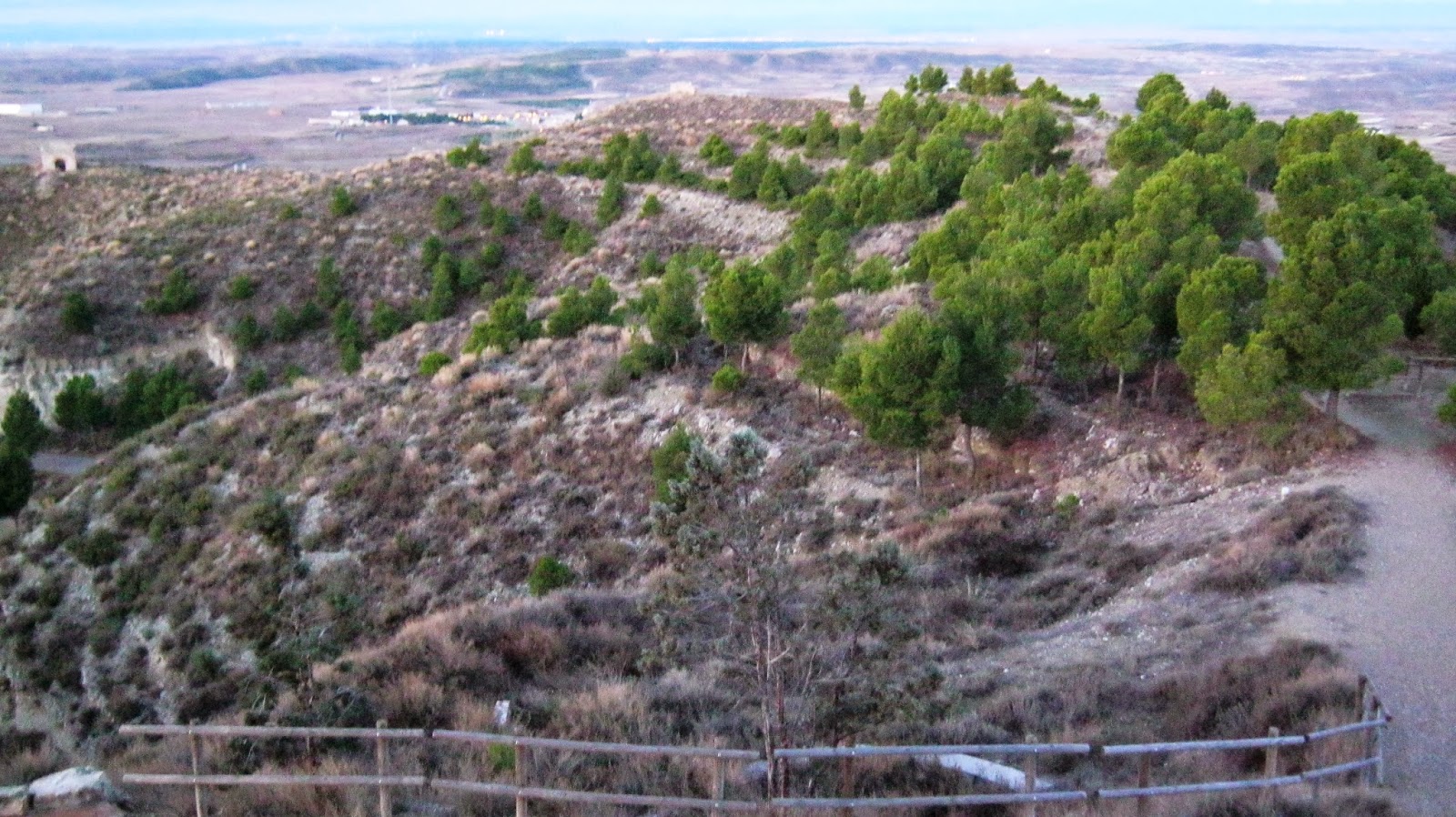
Slightly different view to show the horse-shoe shape of the hills in Aragón. 
As described by Orwell in 'Homage to Catalonia'
The small building was a penance pit for naughty monks.
No doubt the Nationalists fortified it.

El Santuario front

El Santuario rear

As a Nationalist HQ El Santuario was heavily defended.
Remains of a HMG post.

View From
Artillery was sited in the area bottom LH corner of picture
The hills in the far distance were held by the Nationalists.
The Republicans, including Orwell, were dug-in just beyond that far line of hills.

UATH!

Friday, 15 November 2013

¡Alertas Milicianos!

Those of you who know of my comings and goings will be aware I have been involved in Spanish Civil War living history for over ten years. In fact I'm off to Spain in less than a week to take part in an event to mark the end of The Battle of The Ebro as well visiting La Ruta Orwell plus several other events: it will be a busy few days so mucha comida will be needed!

As well as studying the war; learning to speak Spanish; contacting and befriending numerous Spaniards and visiting Spain I have also collected quite a lot of kit. It used to be very cheap and plentiful but given the explosion of interest in Spain this is less so now. It is sometimes hard to believe that SCW living history in Spain has gone from nothing to this in about ten years.

Pictures of (some) of my kit:

POUM Pigskin Jacket
Qué chulada!


Spanish army blanket. 
Bought it in Madrid from El Rastro Market.

Italian army blanket. 
Excess stock from Captain Corelli's Mandolin

Capote front 
A capote is an army style poncho which goes over the head and shoulders.
Note the 'patch' at the front for putting your hands in.
Well darned too!

Capote back
Showing the belt which is used to tighten the garment up once it's on.

Capote collar detail.
Once on the soldier's leather webbing and cartridge boxes can be worn quite easily over the top.
A very warm garment.

Puttees
Very popular with POUM militia.
Mine are made from 3 pairs of British army short puttees sewn together.
It's now much easier to buy full length sets.
Important to practice putting them on to avoid droopiness.

Repro Army gorillo cap with red (infantry) piping but without a tassle at the front. 
Note how the bottom of the cap curves slightly to sit more squarely on the head.
You can just see a red star at the front; true vintage in that it is stamped not cast.


Una cantimplora - repro

Cantimplora detail.
Note spring clip for attaching to a convenient point.

Eating Irons
The plate and cup are post-war but the design was the same.
The cup is a devil to drink hot coffee from. 
I usually unclip the leather strap, form it into a handle and sip from the narrow side.
The spoon fork combination is war vintage and very useful.

Leather Spanish army webbing.
3 pouches, 2 at the front one at the back.
Waist belt and shoulder straps.
Often worn with just the waist belt and pouches.
Sometimes the shoulder straps were criss-crossed over the chest.

Pouch detail
Pouches were either sewn or rivetted together.

Belt plate detail
The Infantry badge.
Other arms of service had different designs stamped.
As the war progressed plain belt plates appeared due to ease of manufacture.

Thursday, 1 August 2013

British Voices On The Hills Part 2

From here we drove to the Memorial Cairn near the hills occupied by the British Battalion. Following a few minutes reflection Juan and Jesús led us to the area which was the Battalion’s HQ position, and also to the site of No.2 Company’s machine gun positions on the 12th February 1937. Crossing the valley we made our way up to the hill that was held by 3 and 4 Companies on the 12th February. In front was Conical hill held by No1 Company. No map can ever prepare you for viewing the ground over which the British volunteers fought and where so many died. It was a truly humbling experience to be there the day after the anniversary of the beginning of the battle for the British Battalion . This was made even more poignant by a remark Jesús made - that the sound of our English voices in the valley was very moving, as this very place would have resounded with English voices some 68 years before.


Memorial Cairn, Jarama

Crossing the saddle from Fry's HMGs towards Suicide Hill

The ridge in the background was No2 (Machine Gun) Company's position

And up Suicide Hill

The Knoll occupied briefly by No1 Rifle Company. 
Taken from Suicide Hill

For those who are interested here's a profile of the battle itself: Jarama Battle

UATH!


Wednesday, 31 July 2013

British Voices On The Hills Part 1

This is an article I wrote for La Columna after a visit to the Jarama battlefield in February 2005. The La Columna web site is being closed down and replaced with a blog so I thought it would be a good idea to save this article from the archive.

El Grupo Inglés Con Sus Camaradas

British Voices on The Hills
Sunday morning saw us being transported by a convoy of cars to Morata de Tajuña along the Valencia road. The driver of the car I was in was Jesús Gonzalez, a member of the AABI. A man whom I met for the first time that morning but within a short space felt like I’d known him for years! On the way Jesús pointed out sites of Spanish Civil War interest including the Arganda bridge and the site of the Lincoln Battalion's HQ.

On arrival in Morata de Tajuna Jesús took us to the Museo El Cid a small agricultural museum behind the restaurant Mesón El Cid. The museum has a large room dedicated to The Battle of Jarama and The Spanish Civil War. The museum has an excellent display with many photographs and many artifacts from the battlefield. It is well worth a visit if you are in the area.


A Selection of Artifacts in The Museum

If you're not familiar with the area this map may help you. From Morata de Tajuña we moved up the San Martin road and then onto 'The Sunken Road', famous for being mentioned so often in accounts of the British Battalion's time at Jarama. We traveled along this for some distance, past Pingarron Hill, to the area held by Enrique Lister’s division. From here we headed back on ourselves to a Republican held hill opposite Pingarron. This is studded with prepared positions and the remains of chabola-type dug-outs. All of these post-date the Battle of Jarama but are of the Civil War.

Me at the entrance to a dug-out

Remains of a concrete pill-box

On top of the pill box

Remains of a prepared artillery position

There was also a curious tunnel that linked an artillery position with safe ground on the other side of the hill which was out of range of the fascist lines. Inside there was the remains of graffiti from the war carved into the soft walls. This tunnel was remarkably intact, and very dark!

Tunnel entrance

In the tunnel

Examining the tunnel walls

Republican grafitti


In Part 2 we travel to the battlefield of Jarama.

PS Welcome to new follower Grigork; I hope you enjoy the voyage!

All the best!